 Arrivl
Every day, more of your future customers start a search by asking an AI. They type a question into ChatGPT, Claude, or Perplexity, and the answer they get is shaped by what those agents were able to read on the web — including, if you're lucky, on your site.
The catch: an agent doesn't experience your website the way a person does. It doesn't wait for animations, click through tabs, or scroll a carousel. It fetches your page, extracts what it can parse in a fraction of a second, and moves on. What it takes away from that visit is what ends up informing the answer — and it's often a very different page from the one your visitors see.
The web has a second audience now
For twenty years, "who visits my site" meant people, and the tools we built — Google Analytics, Hotjar, session replay — all assume a human on the other end. AI agents break that assumption. They arrive without cookies, rarely run your JavaScript, and never show up in a funnel. Most analytics stacks filter them out as noise.
That's a problem, because the agent's read of your page is now a distribution channel. When it can't parse what your product does, you don't get a bad ranking — you get left out of the answer entirely.
What an agent actually reads
Think of it as the machine-readable layer underneath your design. When a well-behaved agent fetches a page, it reliably reads:
- Server-rendered text — the HTML that arrives in the initial response, before any client-side rendering.
- Headings and structure — your
h1/h2hierarchy is how it understands what the page is about. - Structured data — JSON-LD and schema markup, which spell out facts (price, product, FAQ) in a format it doesn't have to infer.
llms.txtandrobotssignals — the files that tell it what you want it to read and how.- Link text and alt attributes — the labels that give context to everything else.
And it quietly skips a lot:
- Content that only appears after JavaScript runs, or after a click, hover, or scroll.
- Text baked into images with no
alt. - Anything gated behind an interaction it can't perform.
If the only place your value proposition lives is a headline animated in by JavaScript, an agent may never see it at all.
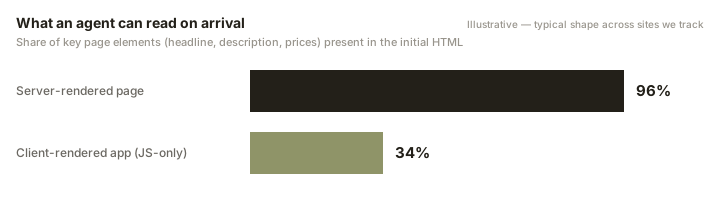 What an agent can read on arrival — on a server-rendered page ~96% of key content is in the initial HTML; on a client-rendered app, ~34%. Illustrative.
Why Google Analytics can't see them
Agents don't browse, so they never trip the client-side beacon GA relies on. From your analytics' point of view, the visit didn't happen. That's why teams are surprised to learn that a meaningful and growing share of their traffic — the share that decides how they show up in AI answers — has been invisible the whole time. You can't optimize a channel you can't measure.
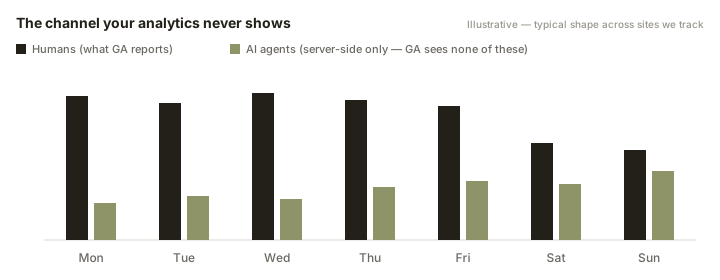 The channel your analytics never shows — a week of visits with GA-reported humans in ink and server-side-only AI agent visits in olive, the olive share growing through the week. Illustrative.
Five checks that decide whether you show up
- Does your key content render server-side? View source (not inspect) and confirm your headline, product description, and prices are in the raw HTML.
- Is there structured data on your important pages? Product, Article, and FAQ schema give agents facts they don't have to guess.
- Do
robots.txtandllms.txtwelcome the agents you want? BlockingGPTBotorClaudeBot— sometimes by accident, via a default security setting — cuts you out at the door. - Are your headings honest? One clear
h1, a sensibleh2outline, no heading-shapeddivs. This is the outline the agent reasons over. - Does the page respond fast and unblocked? Challenges, interstitials, and slow responses read as failures. An agent that gets a 403 or a spinner learns nothing.
How to know for sure
You can work through that checklist by hand, page by page. Or you can point Arrivl at your domain and get the machine's-eye view directly: which agents are visiting, which pages they read, what they parse on each one, and the specific fixes that move the needle — scored, not guessed.
The web has a second audience now. The teams measuring it today are the ones writing the playbook everyone else copies next year.